To learn more about how Policy Deployment can help you and your organization, contact DNHanink Consulting---Phone: 330.528.0454, Email: dnhanink@aol.com OR The PARTNERSHIP---Phone: 216.932.2391, Email: ibrooks@netzero.net February, 2002 |

">

">
">
">
POLICY DEPLOYMENT. . . . . . |

. . . . creating an environment that works for everyone |
by Dennis N. Hanink and Isaac C. Brooks, Jr. "When all is said and done, more is said than done." -Vince Lombardi BACKGROUND Change is a constant in every vibrant business. Whether capitalizing upon growth opportunities or improving operational performance or, more often, a combination of the two, changing the way an organization conducts its affairs is necessary. Sometimes a radical change or transformation is required. Resources beyond those needed for operating the business today are required in order to effect any change. It is the manner, as much as the amount, in which these discretionary resources are committed, that determines the direction and speed of change. Resources may be in the form of cash purchases of expense items or capital equipment, but they also include the time and talent commitment of the men and women who make up the organization. PURPOSE Policy Deployment is a leadership process resulting in a document that aids in mobilizing an organization and aligning the commitment of unit resources to the long-range goals of the organization. The policy deployment document has a closed-loop format summarizing long-term organization goals and displaying the short-term actions planned to achieve them. It is reviewed regularly and refreshed throughout the fiscal year so that it is a living document, not a product of an isolated and frenzied event or two scheduled during a fiscal planning cycle. |

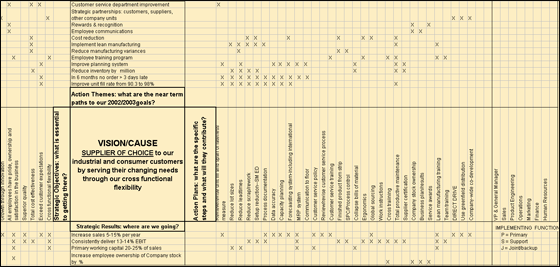
VISION/CAUSE A vision statement succinctly presents an organization's aspirations. It provides a guiding purpose that drives decisions and behaviors. The most powerful visions, when supported by consistent leadership behaviors and human resource policies, engender such a strong commitment by organization members that they become a "cause" for which the members extend themselves. For example: Charles Schwab's cause is "To be the most ethical and useful financial services company in the world." STRATEGIC RESULTS Organizations need to be able to measure their progress in attaining their vision. Strategic results reflect that set of long term (3-5 years) performance targets or goals based upon the progress metrics. They generally encompass direct financial measures, such as sales growth, profitability and asset management. But they also may include other important issues with a much less direct financial connection, such as employee turnover, attendance, the speed of new product introductions or the level of customer satisfaction. For example: 'Grow revenue by 10-15% annually'; or 'Achieve primary working capital of 20% to sales'; or 'Achieve 25% return on assets employed'; or 'Engage all employees in continuous improvement activities'. STRATEGIC OBJECTIVES Strategic objectives are qualitative statements that characterize the organization. They describe in broad terms what the organization has to do to achieve the strategic results. For example: 'Superior product availability', or 'Flexibility to accommodate rapidly changing customer needs', or 'Innovating with the best technology fit for solving customer problems', or 'Skilled at recruiting, training and managing a seasonal workforce'. IMPROVEMENT GOALS Short-term (12 months, more or less) improvement goals are interim milestones for gauging progress in achieving the strategic results. These goals should be statements that use action verbs stating what is to be achieved in what period of time. Goals should require stretch performance in order to encourage creativity and challenge the status quo and to insure that the results are important to the organization, not trivial. For example: 'Generate 1% per month in cost reductions'; or 'Achieve inventory turns of 15 by yearend'; or 'Conduct kaizen workshops that involve 25% of all employees by yearend'. ACTION PLANS Specific projects undertaken to achieve the improvement goals. These projects will require program management and progress reporting. Managers can use formats such as storyboards or Ghant charts. These formats provide details showing 'what,' 'who,' 'when,' and 'how' the project will be accomplished. For example: 'Reduce finished goods inventory by $1M within 6 months'; or 'Conduct one kaizen event monthly'; or 'Initiate 5S throughout the shop within 4 months'. Each of these projects may require many individual actions to be taken for which the timing, resources and responsibilities are clearly spelled out by the project plan. It is possible to capture all facets of the Policy Deployment plan on a single sheet of paper. All elements are mapped and tested for consistency. The SAMPLE Policy Deployment map below displays functional and/or individual accountabilities for elements of the deployment plan. |
In short, Policy Deployment |
describes how discretionary resources will be used |
provides a tool for communicating the organization's direction with a balance between short and long term time horizons and goals |
provides a tool for helping insure a disciplined and efficient business planning process |
To learn more about how Policy Deployment can help you and your organization, contact DNHanink Consulting---Phone: 330.528.0454, Email: dnhanink@aol.com OR The PARTNERSHIP---Phone: 216.932.2391, Email: ibrooks@netzero.net February, 2002 |